Friday, April 15, 2016

A Bibliography of Studies in English on the Coherence and Structure of the Qur'an's Suras

Cross posted from: http://blog.bayyinah.com/nazm-bibliography

The topic of the Qur'an's naẓm, "arrangement" or "composition," has achieved significant interest in contemporary study of the scripture, giving rise to a number of extremely interesting and insightful studies of the coherence and structure of the Qur'anic suras.  Here I would like to provide a bibliography of such studies in English for interested readers and students of the Qur'an.  This post can be continually updated as further studies in this field are published.

First, however, I would like to give mention of two contemporary pioneering works outside of the English language.  First, Amin Ahsan Islahi has written a commentary of the entire Qur’an in Urdu focused on the study of coherence, titled Tadabbur-i Qur’ān (Pondering the Qur’an).  His commentary of suras 32-114 have been translated into English and may be found on http://www.tadabbur-i-quran.org/text-of-tadabbur-i-quran/.  For studies of this commentary in English, see Mustansir Mir, Coherence in the Qur'an (Indianapolis: American Trust Publications, 1986), as well as Neal Robinson, Discovering the Qur’an: A Contemporary Approach to a Veiled Text, 2nd ed. (Washington, D.C.: Georgetown UP, 2003), pp. 271-283.

Second, the formal structure of all of the Meccan suras, and especially the early Meccan suras, has been studied by Angelika Neuwirth, Studien Zur Komposition Der Mekkanischen Suren (Berlin: De Gruyter, 1981). Although this work has yet to be translated into English, her findings are refined by Robinson, Discovering the Qur’an: A Contemporary Approach to a Veiled Text), pp. 97-161.  Neuwirth’s structural or thematic divisions of the Meccan suras are also outlined in an appendix by Carl Ernst, How to Read the Qur’an: A New Guide, With Select Translations (Chapel Hill: University of North Carolina Press, 2011), pp. 213-222.  

What follows is a bibliography of coherence-based studies of particular suras in English.

MECCAN SURAS

Sura 1: The Opening (al-Fātiḥa)
  • Michel Cuypers, “Semitic Rhetoric as a Key to the Question of the Naẓm of the Qur’anic Text” Coherence in the Qur’an 13 no. 1 (2011): 13-15.
  • Raymond Farrin, Structure and Qur’anic Interpretation: A Study of Symmetry and Coherence in Islam’s Holy Text, Ashland, OR: White Cloud Press, 2014, 1-7.
Sura 12: Joseph (Yusuf)
  • Mustansir Mir, “The Qur’anic Story Of Joseph: Plot, Themes, And Characters,” Muslim World1 (1986): 1-3, points out the chiastic structure of the sura.
  • Michel Cuypers, “Semitic Rhetoric,” 15-19, offers a deeper and more refined analysis of the sura as a ring composition.
Sura 15: al-Ḥijr
  • Ernst, 111-120, underscores the structure of the sura and its anchors with earlier suras.
Sura 17: The Night Journey (al-Isrā’)
  • Robinson, Discovering the Qur’an, 188-195.
Sura 23: The Believers (al-Mu’minūn)
  • Neal Robinson, “The Structure and Interpretation of Sūrat al-Mu’minūn,” Journal of Qur’anic Studies 2, no. 1 (2000): 89-106.
Sura 51: The Scatterers (adh-Dhāriyāt)
  • Mir, Coherence in the Qur’an, 39-41, summarizes Hamid al-Din Farahi’s analysis of the sura.
  • Ernst, 78, outlines the structure and balance of the sura.
Sura 53: The Star (an-Najm)
  • Ernst, 98-104, provides some observations on the structure and balance of the sura.
Suras 54: The Moon (al-Qamar) and 55: The All-Merciful (ar-Raḥmān) (as a sura pair)
  • Farrin, Structure and Qur’anic Interpretation, 63-69.
Sura 55: The All-Merciful (ar-Raḥmān) – also 54 and 56
  • Muhammad Abdel Haleem, “Context and Internal Relationships: Keys to Qur’anic Exegesis” Approaches to the Qur’an, eds. G. R. Hawting and Abdul-Kader A. Shareef (London: Routledge, 1993), 71-98; also presented in Muhammad Abdel Haleem, Understanding the Qur’an: Themes and Styles, 3rd ed. (London: I.B. Taurus, 2011), 161-186.
Sura 75: The Resurrection (al-Qiyama)
  • Neal Robinson, “The Qur’ān as the Word of God” in Heaven and Earth: Essex Essays in Theology and Ethics, ed. Andrew Linzey and Peter J. Wexler (Worthing: Churchman, 1986), 38-54.
  • Salwa M.S. El-Awa, Textual Relations in the Qur’ān: Relevance, Coherence, and Structure (Routledge: New York, 2006), 101-159.
Sura 78: The News (an-Naba’)
  • Robinson, Discovering the Qur’an, 167-176.
Sura 79: The Pullers (an-Nāzi‘āt)
  • Robinson, Discovering the Qur’an, 177-188.
Sura 101: The Crashing Blow (al-Qāri‘a)
  • Cuypers, “Semitic Rhetoric,” 7-9.

MEDINAN SURAS

Sura 2: The Cow (al-Baqara)
  • Mustansir Mir, “The Sūra as a Unity: A Twentieth Century Development in Qur’an Exegesis” in Approaches to the Qur’an, eds. G. R. Hawting and Abdul-Kader A. Shareef, eds. (London: Routledge, 1993), 211–24; reprinted in Colin Turner, ed., The Koran: Critical Concepts in Islamic Studies (4 vols. London: Routledge, 2004), vol. 4, 198–209.
  • Robinson, Discovering the Qur’an, 201-223.
  • H. Mathias Zahniser, “Major Transitions and Thematic Borders in Two Long Sūras: al-Baqara and al-Nisā’” in Literary Structures of Religious Meaning in the Qur’an, ed. Issa J. Boulatta (Richmond: Curzon, 2000), 26–55.
  • David E. Smith, “The Structure of al-Baqarah,” Muslim World 91 (2001): 121–36.
  • Raymond Farrin, “Surat al-Baqara: A Structural Analysis,” Muslim World1 (2010): 17-32.
  • Farrin, Structure and Qur’anic Interpretation, 9-21.
  • Nevin Rida El-Tehry, Textual Integrity and Coherence in the Qur’an: Repetition and Narrative Structure in Surat al-Baqara (PhD diss., University of Toronto, Toronto, 2010).
Sura 3: The House of ‘Imrān (Āl ‘Imrān)
  • Neal Robinson, “Surat Al ‘Imran and Those with the Greatest Claim to Abraham,” Journal of Qur'anic Studies 6, no. 2 (2004): 1-21.
  • Neal Robinson, “The Dynamics of Surah Āl ‘Imrān” Pak Tae-Shik, Saramui Jonggyo, Jonggyoui Saram (Seoul: Baobooks, 2008), 425-486.
  • Farrin, Structure and Qur’anic Interpretation, 24-32.
  • Bilal Gökkir, “Form and Structure of Sura Maryam—A Study from Unity of Sura Perspective,” Süleyman Demirel Üniversitesi İlahiyat Fakültesi Dergisi 16, no. 1 (2006): 1-16.
Sura 4: Women (an-Nisā’)
  • Mustansir Mir, Coherence in the Qur’an (Indianapolis: American Trust Publications, 1986), 46-62, provides a summary and analysis of Islahi’s study of the structure and coherence of the sura.
  • A. H. Mathias Zahniser, “Major Transitions and Thematic Borders in Two Long Sūras: al-Baqara and al-Nisā” in Literary Structures of Religious Meaning in the Qur’an, ed. Issa J. Boulatta (Richmond: Curzon, 2000), 26–55.
  • A. H. Mathias Zahniser, “Sura as Guidance and Exhortation: The Composition of Surat al-Nisa” in Humanism, Culture, and Language in the Near East: Studies in Honor of Georg Krotkoff, ed. Asma Afsaruddin and A.H. Mathias Zahnisr (Winona Lake, Ind.: Eisenbrauns, 1997), 71-86.
Sura 5: The Dining Table (al-Mā‘ida)
  • Neal Robinson, “Hands Outstretched: Towards a Re-Reading of Surat al-Mā’ida” Coherence in the Qur’an 3, no. 1 (2001): 1-19.
  • Michel Cuypers, The Banquet: A Reading of the Fifth Sura of the Qur’an, trans. Patricia Kelly (Miami: Convivium Press, 2009); cf. Cuypers, “Semitic Rhetoric,” 9-13.
Sura 33: The Confederations (al-Aḥzāb)
  • El-Awa, Textual Relations in the Qur’ān, 45-100.
Sura 60: She Who is to Be Examined (al-Mumtaḥana)
  • Ernst, 163-166, analyzes the sura as a ring composition.
Suras 113: Daybreak (al-Falaq) and 114: Mankind (an-Nās) as a sura pair

  • Farrin, Structure and Qur’anic Interpretation, 22-24.

Friday, March 4, 2016

Demystifying "Gog and Magog" in Judeo-Christian Tradition, the Qur'an, and the Hadiths

Adeel, the author of the "Quran Answers" blog, has just published an excellent essay on the topic of Gog and Magog in the Qur'an and hadiths.  I felt this was worth posting about, because the topic of Gog and Magog has become the subject of a lot of misunderstanding, wild conjecture, and bizarre interpretations.  But, while it represents an apocalyptic motif shared by Jewish, Christian, and Islamic tradition, it is in fact grounded in a well-known historical phenomenon with historical, geographical, and ethnic identifiers.  Before posting the link to the "Quran Answers" article, I thought it would be worth providing some historical context to this misunderstood tradition.

The basic historical understanding of "Gog and Magog"[1] across the Abrahamic traditions is summed up well by Abdullah Yusuf Ali in an appendix of his Qur'an translation and commentary:
It is practically agreed that they were the wild tribes of Central Asia which have made inroads on settled kingdoms and Empires at various stages of history. The Chinese Empires suffered from their incursions and built the Great Wall of China to keep out the Manchus and Mongols. The Persian Empire suffered from them at various times and at various points. Their incursions into Europe in large hordes caused migrations and displacements of populations on an enormous scale, and eventually broke up the Roman Empire. These tribes were known vaguely to the Greeks and Romans as "Scythians", but that term does not help us very much, either ethnically or geographically.[2]
A.R. Anderson catalogs some of the earliest recorded examples of these incursions:
From time immemorial the Caucasus—that mighty bulwark thrown across the isthmus between the Black and the Caspian Seas—has lain in the pathway of northern nomads descending into the fair lands of Hither Asia. What devastating waves of migration have burst against its barriers, some of them to clear its passes and to deal destruction to the civilizations of the south! Such may have been the course of the Kassites when about 1900 B.C. they came bringing with them the horse, but wrecking the empire founded by Hammurabi. Such too may have been the course of the Mitanni, when they about 1400 B.C. made themselves felt as far as Palestine. It was probably through the pass of Dariel that the Cimmerians, Gimirrae, who are to be identified with the biblical Gomer, invaded Assyria under Sargon (722-705 B.C.) and then later passed on to overrun Asia Minor, devastating it as far as the Aegean, and overthrowing the power of Phyrgia founded by Midas. A generation later under Esar-Haddon (681-668 B.C.), the Scythians followed by way of the pass of Derbend, destined before the century was past to join the Medes and Chaldeans in overthrowing Assyria (612 B.C.). East of the Caspian the Massagetae constituted a problem even to Cyrus the Great. Darius, recognized the Scythian peril, sought to strike them by way of the Balkan peninsula, crossing the Danube in an in an expedition in which he narrowly escaped utter ruin. [3]
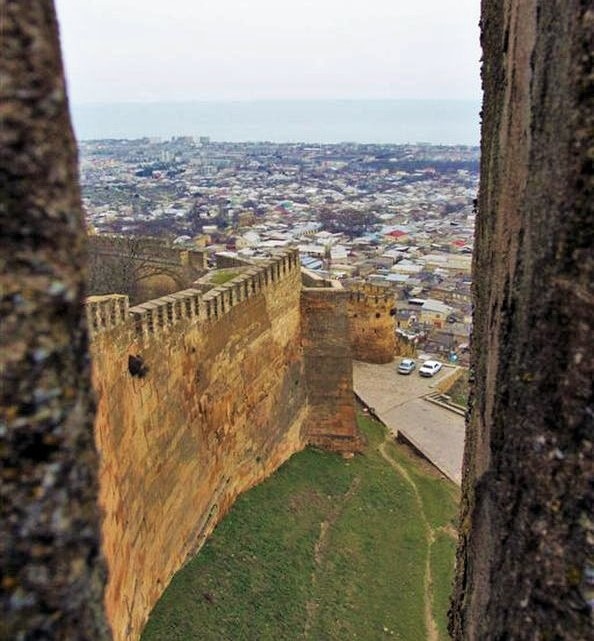
Such incursions continued well into the Common Era.  The term "Scythians," or later "Huns," became a generic designation for Central Asian nomadic tribes who occupied the northern parts of the Caucasus.  The people of Asia Minor and the Caucasus would build defensive walls in the Caucasian mountains, such as the Pass of Dariel and the Gates of Derbend in modern-day Russia, to protect them from from invasions by these tribes from the north.  The Huns, of course, ravaged Europe in the late fourth and fifth centuries, contributing to the fall of the Western Roman Empire.  In the following centuries, the Sabirs, Kök Türks, and Khazars posed repeated threats to Byzantine and/or Persian territories in the Near East.  In the climax of the centuries long Byzantine-Sassanian Wars, the Byzantine Emperor Heraclius even opened the Gates of Derbend and summoned the Kök Türks and Khazars against his Sassanian Persian opponents.


The Gates of Derbend in modern-day Russia, also known in popular tradition as the Gates of Alexander.
(Courtesy of Wikipedia.)

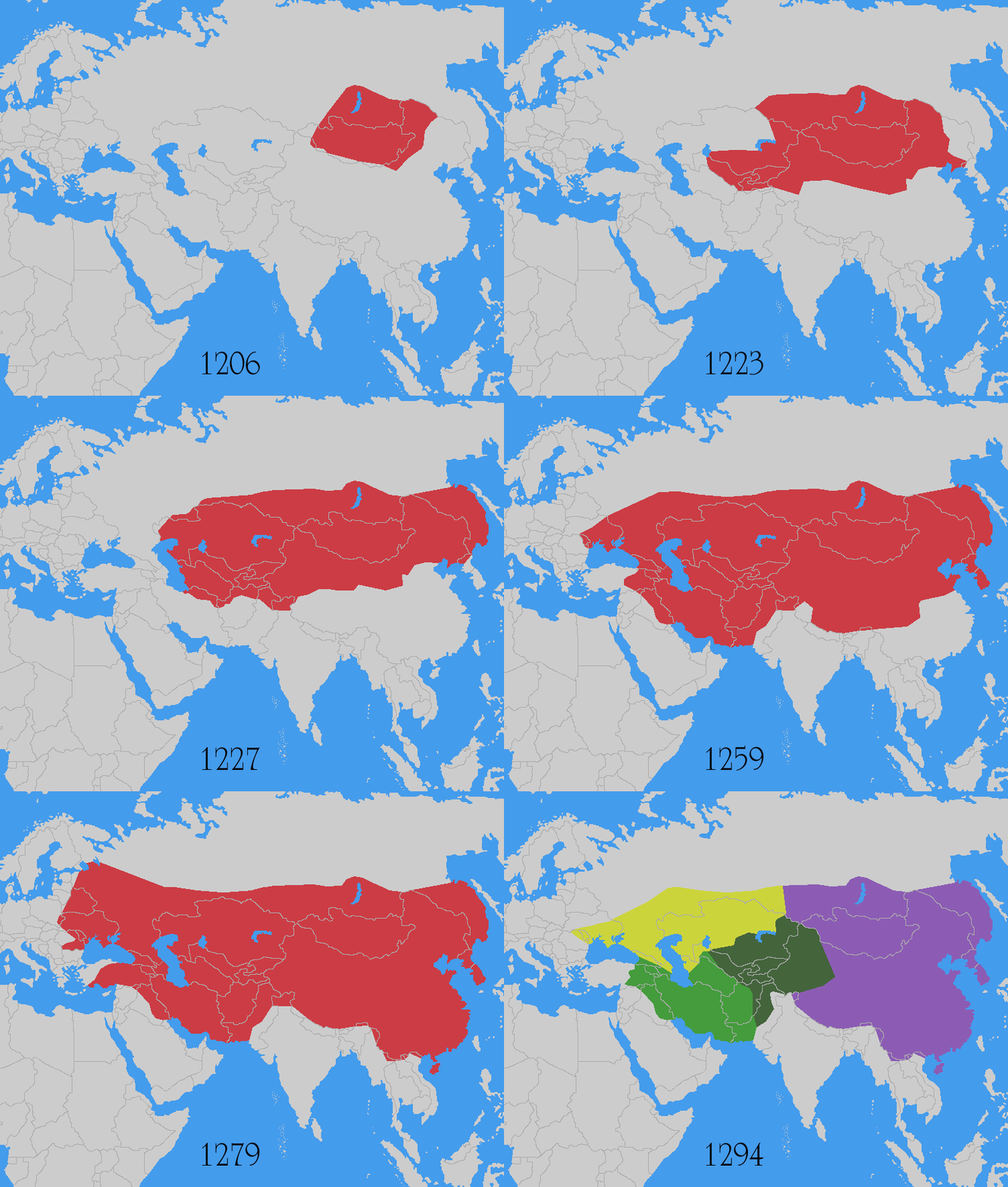
Notwithstanding, the most devastating manifestation of this phenomenon occurred centuries later: the Mongol invasions and conquests of the thirteenth century.


The expansion of the Mongol Empire.
(Courtesy of Wikipedia, user Astrokey 44.)

In summary, Schmidt and Van Donzel write:
[Gog and Magog] were identified with different “impure peoples”: Scythians, Huns, Alans, Khazars, Turks, Kipchaks, or the Mongols. The common denomination of these peoples is that they all were accomplished horsemen who invaded the Roman Empire from the Eurasian steppes and whose civilisations were unknown to the citizens of the Roman Empire.[4]
 Speaking more broadly, Anderson states:
The term Gog and Magog has therefore become synonymous with barbarian, especially with the type of barbarian that bursts through the northern frontier of civilization. This frontier extends the whole length of the Eurasian continent from the Atlantic to the Pacific, from Spain to China, and includes such outstanding landmarks as the Alps, the Caucasus, and the Great Wall[5]…The legend of Alexander’s Gate and of the enclosed nations is in reality the story of the frontier in sublimated mythologized form.[6]
The Gog/Magog tradition has evolved over the course of the Abrahamic traditions, from the mention of Magog as a descendent of Noah's son Japheth in the Table of Nations (Genesis 10:2), to the proto-apocalyptic prophecy about the armies of "Gog of Magog" in Ezekiel 38-39, to further apocalyptic development in Second Temple Jewish texts and early Christian and Rabbinic writings, to their infusion with the Alexander legends in the Late Antique period, and in their presentation in the Qur'an (18:93-99; 21:95-96) and prophetic hadiths.

Adeel's essay provides a fairly straightforward reading of the Qur'anic verses and (frequently misunderstood) hadiths on the topic of Gog and Magog, along with helpful analysis from medieval and modern Muslim scholars.  The essay clarifies:
  • What the hadiths say about the ethnic identity and geographical location of "Gog and Magog";
  • How the hadiths seem to have prophesied the Mongol invasions many centuries before they occurred;
  • That the fortification that restrained Gog and Magog (see Qur'an 18:93-99) may have already been breached, rather than being a future event;
  • That the invasions of Gog and Magog are not restricted to a single apocalyptic event, but are a transhistorical phenomenon, recurring across history, but culminating in their most catastrophic manifestation immediately before the Last Day;
  • How this catastrophic event fits into the ends times chronology presented in the hadiths;
  • What the hadiths about their enormous numbers mean.
It is also notable that the hadiths cited in the essay have many parallels with Ezekiel 38-39 and Rabbinic traditions.  This is an enlightening read for anybody who has been confused about this topic:


[1]  The etymology of these names is uncertain.  For a summary of several theories, see J. Lust, “Magog” in Karel Van Der Toorn, Bob Becking, and Pieter W. van der Hoorst (eds.), Dictionary of Demons and Deities in the Bible (Leiden: Brill, 1999), 2nd ed, pp. 535-536.  Magog occurs in the Table of Nations in Genesis 12 as a nation descending from Noah’s son Japheth, the progenitor of European and certain Asian peoples.  “Gog” first occurs in the prophecy in Ezekiel 38-39, where he is the political and military head of the region of Magog.  In the second century BCE, “Gog” occurs in place of “Magog” in the Book of Jubilees, and they subsequently occur as counterpart tribes in the third book of the Sibylline Oracles.  In the Qur'an, the paired names are made to rhyme—Ya'juj and Ma'juj—as is a common literary feature of the scripture.
[2]  Abdullah Yusuf Ali, The Holy Qur'an: Arabic Text with an English Translation and Commentary (Lahore: Shaykh Muhammad Ashraf, 1937), vol. 2, p. 761.
[3]  Andrew Runni Anderson, “Alexander at the Caspian gates,” Transactions and Proceedings of the American Philological Association 59 (1928): 138–139.
[4]  Andrea and Emeri Van Donzel (eds.), Gog and Magog in Early Syriac and Islamic Sources: Sallam’s Quest for Alexander’s Wall (Leiden: Brill, 2009), p. 45.
[5]  Here Anderson is considering post-Qur’anic interpretations, such as that the Mongol invasions represented Gog and Magog. Nonetheless, it is an accurate characterization of Gog and Magog as a transhistorical typology.
[6]  Andrew Runni Anderson, Alexander's Gate, Gog and Magog, and the Inclosed Nations (Baltimore: The Waverly Press Inc., 1932), p. 8.

Monday, July 20, 2015

Traveling over next few weeks

As-salamu `alaykum all.  Insha'allah I will be traveling over the next several weeks and will not be able to continue my blog posts as planned, but hope to resume them in the second half of August.  Jazakumullahu khayran to all those who are reading!

Sunday, June 7, 2015

The Exodus in the Qur’an, the Bible, and History (Part 10): "King" vs. "Pharaoh"

In English, “pharaoh” is used as a generic term for any king (or queen) of ancient Egypt, without distinguishing between different periods or dynasties.  This is how the term is used in the Bible as well.  In the stories of Abraham and Joseph, which are almost universally located in the Middle Kingdom period (c. 2055-1650 BCE), the ruler of Egypt is called “Pharaoh” over ninety times.  Likewise, in the story of Moses, which is almost universally located in the New Kingdom period (c. 1550-1069 BCE) (see part 6, “The Identity of Pharaoh”), the Egyptian ruler is called “Pharaoh” 128 times.[1]  The term “king of Egypt” is also used in both the stories of Joseph (Gen. 40:1; 41:46) and Moses (Exod. 6:13, 27; Deut. 11:3).  Therefore, in the Bible, the terms, “Pharaoh” and “king of Egypt” are both used for both time periods without distinction.[2]

The Qur’an is therefore peculiar in that it does not follow the biblical pattern.  It does use both terms, “Pharaoh” and “king,” but without mixing between them.

In the story of Joseph, the Qur’an consistently refers to the Egyptian ruler as al-malik (“the king”), and never as Fir‘awn (“Pharaoh”).  For example,

The king (al-malik) said, ‘I dreamed about seven fat cows being eaten by seven lean ones; seven green ears of corn and [seven] others withered.  Counselors, if you can interpret dreams, tell me the meaning of my dream.’ (12:43)

Further references to the ruler as “the king” occur in āyas 50, 54, 72, and 76.

On the other hand, in the various retellings of the story of Moses in the Qur’an, the Egyptian ruler is consistently referred to as Fir‘awn—over seventy times—and never as al-malik.  For example,

And Moses said, ‘O Pharaoh, I am a messenger from the Lord of all peoples’ (7:104)

What is surprising about the Qur’an’s usage is that it accords precisely with the way the term “Pharaoh” was historically used in ancient Egyptian history.  The term comes from the Egyptian pr-‘3, meaning “great house.”  Prior to the New Kingdom period, the term was used to refer to the royal palace as a whole.  It is only during the New Kingdom period, and specifically the eighteenth dynasty (16th-14th centuries BCE), that the term came to specially designate the Egyptian ruler.  As we saw in part 6, this is exactly the time the Exodus is dated.

The Qur’an’s selective usage of the terms “Pharaoh” and “king” is therefore striking in its precision.  The Qur’an could employed any of the following possibilities:
  1. It could have used both terms for both times periods, just as in the Bible and even modern English, without any distinction.
  2. It could have exclusively used the term “Pharaoh” for both time periods.
  3. It could have exclusively used the term “king” for both time periods.
  4. It could have used the term “Pharaoh” for the period of Joseph and “king” for the period of Moses.
  5.  Instead, the Qur’an uses the term “king” exclusively for the period of Joseph and the term “Pharaoh” exclusively for the period of Moses.

From the perspective of a seventh-century Arab, Jew, or Christian, any of these possibilities would be acceptable, and there would be little to favor one over the other.  The historical distinction between the two epithets has only come to light with the advent of modern Egyptology following the translation of hieroglyphics in the nineteenth century.  In light of these facts, the Qur’an’s usage is an impressive example of one of its most remarkable features, its stunningly precise word choice.


[1] “Pharaoh” in O. Odelain and R. Séguineau (Trans. M. J. O'Connell), Dictionary Of Proper Names And Places In The Bible, 1981, Robert Hale Ltd.: London, p. 301-302.  Cited in David, Karim, and Saifullah.
[2] I have summarized this information from A. David, E. Karim, and M.S.M. Saifullah, “Qur’anic Accuracy Vs. Biblical Error: The Kings & Pharaohs Of Egypt.”  Islamic-Awareness.org, 3 Mar. 2006.  Accessed 2 Feb. 2015.  (For the record, though the Qur’an’s precise and selective usage of these terms is remarkable, I do not personally regard the biblical usage as an “error.”)  One may consult the essay for a more detailed explanation, with more extensive reference to the scholarly literature.

Monday, May 11, 2015

The Exodus in the Qur’an, the Bible, and History (Part 9): The Preservation of Pharaoh’s Body

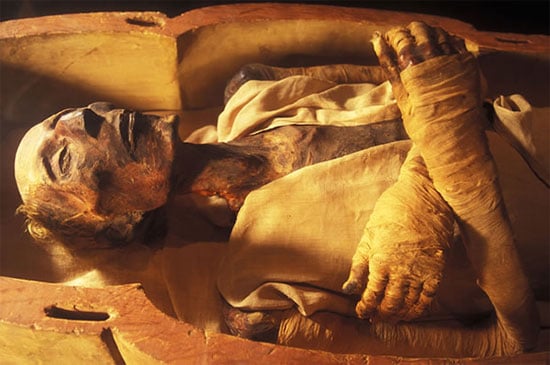
The mummified body of Ramesses II was discovered in 1881 in a cache of forty mummies.  Priests had deposited and concealed these mummies around 1,000 BCE because of an epidemic of grave robbery.  They remained concealed for almost three thousand years until their discovery less than two centuries ago.[1]

This finding confirms another distinctive element of the Qur’an’s narrative of Pharaoh, its claim that his body would be preserved for later generations:

Today We will save you in your body so that you may be a sign for those after you.  Truly many people are heedless of Our signs. (10:92)

This claim is unique to the Qur’an, and is not found in the Bible or any prior Jewish or Christian sources.  This āya has been compared before to some rabbinic tales in which the Pharaoh repented and God rescued him, so he went on to become the king of Nineveh.[2]  However, the obvious implication of this āya is that Pharaoh’s last-minute recantation was not deemed acceptable and he drowned, but his body was in some way preserved as a sign for later generations.  The Qur’an here and elsewhere emphasizes Pharaoh’s demise as a punishment for his crimes.

It is significant that the Qur’an never makes a similar statement about other destroyed peoples, but only states that their abandoned buildings, ruins, or “news” have been made signs for later generations.  This āya explicitly specifies that Pharaoh’s body was preserved as a sign, and not just for his own time or witnesses (as some commentators have suggested), but in open terms—“for those after you” (li-man khalfa-ka).  As Fatoohi and Al-Dargazelli point out, “Since its discovery, Ramesses II’s mummy has been seen by people from everywhere.  It is currently one of the major tourist attractions in the Egyptian Museum in Cairo.”[3]


The mummy of Ramesses II


An objection that has been raised before is that at the time of death, Ramesses was at the ripe age of ninety and was suffering from atherosclerosis as well as battle wounds.  He would have not been in the physical condition to pursue the Israelites into the desert.  The Bible answers this objection best when it states that Pharaoh’s stubborn and reckless actions were a consequence of God hardening his heart, in order that God may display His signs against him (Exod. 7:3), or as the Qur’an says, “as a sign for those after you.”


[1] Fatoohi and Al-Dargazelli, 112.
[2] Pirke De Rabbi Eliezer, ch. 43, pp. 341-343 (Friedlander); Book of Jashar 81:36-41; Chronicles of Jerahmeel 48:12; Legends of the Jews, vol. 3, 29.  Moreover, each of these sources postdates the Qur’an.
[3] Fatoohi and Al-Dargazelli, 114.

Wednesday, April 29, 2015

The Exodus in the Qur’an, the Bible, and History (Part 8): The Pharaoh’s Claim to Divinity

One of the major narrative differences between the Qur’anic account of the Exodus and the Biblical one is the Qur’an’s emphasis on the Pharaoh’s claim to divinity.  The Qur’an narrates:
Then he gathered (his people) and proclaimed, “I am your Lord, Most High.”  So Allah seized with the exemplary punishment of the hereafter and the former. (79:23-25) 
 Pharaoh said, “O my chief!  I do not know of any god for you other than me” (28:39)[1]
Today it is common knowledge that the Pharaohs of ancient Egypt claimed divine status, so the statements of Pharaoh that the Qur’an reports here come as no surprise.  However, this element of the narrative is unique to the Qur’an’s account of the Exodus.  The Pharaoh’s claim to divinity does not play an important role in the biblical text, and in fact, lacks any explicit mention of it at all.  This is also the case with the retellings of the Exodus story in the Jewish pseudepigrapha (extrabiblical writings between 300 BCE and 300 CE), such as the Book of Jubilees, and likewise (as far as I am aware) with rabbinic accounts.  The Pharaoh’s claim to divinity is distinctive to the Qur’an’s account; it lacks any biblical, Jewish, or Christian precedents.  Yet, it is also historically accurate:
By the early New Kingdom, deification of the living king had become an established practice, and the living king could himself be worshipped and supplicated for aid as a god.[2]
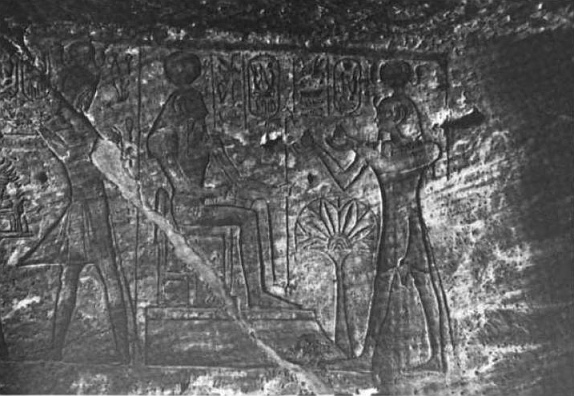
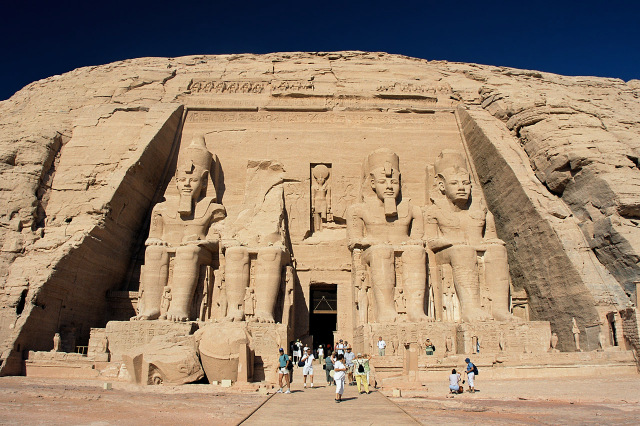
Two steles, 410 and 1079 of the Hildesheim Museum, each describe Ramesses II as “Ramesses-meryamun, the God,” and the Papyrus Anastasi II praises Ramesses as “god,” “herald,” “vizier,” and “mayor.”  The Great Temple at Abu Simbel (see the picture in the part 7) was built by Ramesses II to honor himself.  The entrance of the temple is flanked by four colossal statues of Ramesses II, which dwarf the statue of the god Re-Horakhty located above it.[3]   The building also contains a relief that depicts Ramesses II making a sacrifice to his divine self:


Relief in the Great Temple at Abu Simbel of Ramesses II making an offering to his divine self.
Courtesy of Islamic-Awareness.org.

It must be kept in mind that Egypt had not been ruled by a pharaoh for more than six centuries before the Qur’an was revealed.  The last independent rulers of Egypt were Cleopatra and her son Caesarion, who reigned until 30 BCE, after which Egypt was taken over by Rome.  While the title of “pharaoh” continued to be appropriated by a number of Roman emperors, the title appears to have died off well before the Christianization of the Roman Empire, and certainly none of the Christian emperors had claimed divinity.

The Qur’an’s reference to the Pharaoh’s claim to divinity is another historically accurate piece of information that is distinctive to its narrative of the Exodus, and is not mentioned in the earlier known biblical or extrabiblical versions of the story.


[1] This is āya is not a denial of the polytheism of Egyptians during the time of Pharaoh, but simply expresses Pharaoh's arrogance.  7:127 affirms that Pharaoh and his chiefs recognized a multiplicity of gods: “The chiefs among the people of Pharaoh said, ‘Will you leave Moses and his people to cause corruption in the land and abandon you and your gods?’”
[2] D. P. Silverman, “Divinities And Deities In Ancient Egypt.” Religion In Ancient Egypt: Gods Myths, And Personal Practice. Ed. B.E. Shafer: London, Routledge, 1991. 64.  Qtd. in “The Identification Of Pharaoh During The Time Of Moses.” Islamic-Awareness.org, 4 Jan. 2012.
[3] See “The Identification Of Pharaoh During The Time Of Moses.”  Islamic-Awareness.org, 4 Jan. 2012.

Monday, April 20, 2015

The Exodus in the Qur’an, the Bible, and History (Part 7): “Pharaoh of the Awtād”

In the previous article, we saw that the distinct evidences from both the Bible and the Qur’an point firmly to an identification of the Pharaoh of the Exodus with Ramesses II. 

One element that is distinctive to the Qur’an’s narrative of Pharaoh is that it describes him several times as “Pharaoh of the Awtād":

The people of Noah and ʿĀd, and Pharaoh of the awtād rejected [the messengers] before them. And Thamūd, and the people of Lot…” (38:12-13)

Have you not considered how your Lord dealt with ʿĀd; the city of Iram of the lofty pillars, the like of which had never been created in the lands; Thamūd who cut the rocks in the valley; and Pharaoh of the awtād…? (89:6-10)

Muslim commentators differed over the meaning of awtād (singular watad) in this epithet, since the word is capable of a variety of meanings.  The most common interpretation is “stakes,” on which Pharaoh crucified people.  However Fatoohi and Al-Dargazelli argue that awtād is used in the Qur’an not to mean “stakes” or “pegs,” but tall structures.[1]  This is the interpretation of “Pharaoh of the Awtād” that al-Qurṭubī relates from Ibn ‘Abbās and ad-Daḥḥāk, in his commentary of 38:12:

Ibn ‘Abbās said, “It means the owner of sturdy construction.”  ad-Daḥḥāk said, “He owned many buildings.  Buildings are called awtād.”  

This makes the most sense in light of 89:6-10, quoted above, because the other nations mentioned are also identified with the construction of lofty, firm buildings.

There is no more appropriate description for Rameses II.  Of all the pharaohs of Egypt, he is the one most famous for his ambitious building projects.  Peter A. Clayton writes:

His genuine building achievements are on a Herculean scale. He added to the great temples at Karnak and Luxor, completed his father Seti’s mortuary temple at Gourna (Thebes) and also his Abydos temple, and built his own temple nearby at Abydos. On the west bank at Thebes he constructed a giant mortuary temple, the Ramesseum. Inscriptions in the sandstone quarries at Gebel el-Silsila record at least 3000 workmen employed there cutting stone for the Ramesseum alone. Other major mortuary temples rose in Nubia at Beit el-Wali, Gerf Hussein, Wadi es-Sebua, Derr and even as far south as Napata.[2]

Similarly, Kitchen states:

certainly in his building-works for the gods the entire length of Egypt and Nubia, Ramesses II surpassed not only the Eighteenth Dynasty but every other period in Egyptian history. In that realm, he certainly fulfilled the dynasty’s aims to satiety.[3]

E.P. Uphill states,

Per Ramesses was probably the vastest and most costly royal residence ever erected by the hand of man. As can now be seen its known palace and official centre covered an area of at least four square miles, and its temples were in scale with this, a colossal assemblage forming perhaps the largest collection of chapels built in the pre-classical world by a single ruler at one time.[4]  

The unique feature about Per Ramesses is that it is the only city of imperial size in the ancient near east, rivalling Heliopolis, Memphis and Thebes in splendour, known to have been entirely planned, built and fully completed under one King.[5]

However, most of what Ramesses II built failed to last.  The city of Pi-Ramesses was abandoned in c. 1130 BCE, after which it was dismantled.  The building materials were used to build the city of Tanis, which now lies in ruins, just as the Qur'an says:
We destroyed what Pharaoh and his people used to build and what they used to erect. (7:137)
Fatoohi and Al-Dargazelli also add the following observation:

The fact that the expression ‘Pharaoh of the awtād’ occurs [in sūra 89] where Thamud’s practice of building houses in mountains is mentioned may suggest that this title also implicitly refers to the two temples at Abu Simbel in Nubia which were cut in the living rock of the mountainside. The first of these, the ‘Great Temple,’ is a huge building with two pairs of colossal seated figures of Ramesses II, each 18 meter high, flanking its entrance. These temples are considered to be Ramesses II's greatest building achievement.[6]


The Great Temple of Abu Simbel.  For more on the temples of Abu Simbel, see “The Identification Of Pharaoh During The Time Of Moses.”  Islamic-Awareness.org, 4 Jan. 2012.

Against this historical background, one can truly appreciate the following āya:

Pharaoh was most surely lofty in the land and most surely he was of the extravagant (musrifīn). (10:83)


[1] See Fatoohi and Al-Dargazelli, 107-111.
[2] Clayton, P. A. (1994). Chronicle of the Pharaohs: The Reign ByReign Record of the Rulers and Dynasties of Ancient Egypt, Thames & Hudson: Slovenia.  Cited in Fatoohi and Al-Dargazelli, 110.  Emphasis added.
[3] Kitchen, K. A. (1982). Pharaoh Triumphant: The Life and Times of Ramesses II King of Egypt, Aris & Phillips ltd: Warminster.  Cited in Fatoohi and Al-Dargazelli, 110.  Emphasis added.
[4] E. P. Uphill, “Pithom And Raamses: Their Location And Significance,” Journal Of Near Eastern Studies, 1968, Volume 27, Number 4, p. 299.  Qtd. in “The Identification Of Pharaoh During The Time Of Moses.”  Islamic-Awareness.org, 4 Jan. 2012.  Accessed 12 Feb. 2015.
[5] E. P. Uphill, The Temples Of Per Ramesses, 1984, Aris & Phillips, Warminster: England, p. 228.  Qtd. in “The Identification of Pharaoh.”
[6] Fatoohi and Al-Dargazelli, 110.